

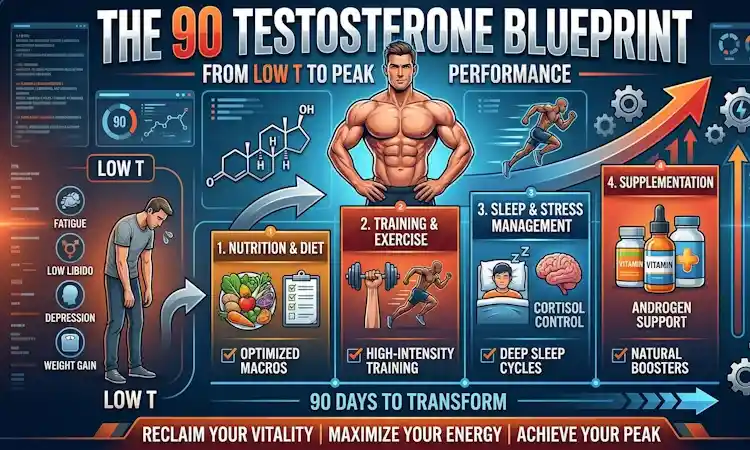
Low energy, poor focus, lower sex drive, slower recovery, stubborn fat gain, and flat motivation are the complaints that push a lot of men to wonder if low T is the problem. If that sounds familiar, the 90 testosterone blueprint: from low t to peak performance is best viewed as a practical 90-day reset, not a magic fix or a promise of overnight change.
Testosterone health is tied to the basics you do every week, sleep, food, training, stress, body fat, and basic medical screening. So this guide puts safe, natural habits first, because real testosterone optimization usually comes from better recovery, smarter eating, consistent lifting, and lower stress, not shortcuts. If you want a deeper look at the lifestyle side of natural testosterone optimization, that foundation matters more than most supplement stacks.
At the same time, major symptoms deserve real testing, not guesswork. If your symptoms are strong, persistent, or getting worse, work with a licensed clinician to review labs and treatment options. With that in mind, let’s start with the high-impact habits that can improve male hormonal health and move you toward peak physical performance.


Start here, know the real signs of low T and what to test first
If you feel off, don’t jump straight to a fix. In the 90 testosterone blueprint: from low t to peak performance, the first step is simple: look for patterns, then confirm them with the right labs.
Low testosterone symptoms can be real, but they are not unique. Your body often sends the same warning signs for stress, poor sleep, under-eating, depression, thyroid problems, and overtraining. That is why smart testosterone optimization starts with honest observation, not guesswork.
The symptoms that deserve attention, not panic
Low T rarely shows up as one dramatic problem. More often, it feels like your usual drive got turned down a few clicks.
You might notice fatigue that sticks around even after a full night in bed. Workouts may feel flatter, weights feel heavier, and recovery takes longer than it used to. Some men also notice lower libido, fewer morning erections, or less interest in sex without a clear relationship issue behind it.
Mood can shift too. You may feel more irritable, less motivated, or emotionally flat. Then there is brain fog, which often feels like trying to think through wet cement. You are not falling apart, but you are not firing cleanly either.
Sleep trouble is another common piece of the puzzle. Some guys struggle to fall asleep, while others sleep long enough but still wake up tired. Over time, rising belly fat can show up as well, especially when your habits have not changed much but your waistline has.
That said, none of these symptoms prove low testosterone on their own. They also overlap with several other common issues, including:
- Ongoing stress
- Poor sleep quality or sleep apnea
- Under-eating or aggressive dieting
- Depression or burnout
- Thyroid problems
- Overtraining and poor recovery
A cluster of symptoms that lasts for weeks matters more than one bad week.
If that sounds familiar, it helps to track what is happening before you test. Write down your energy, sleep, libido, mood, and training performance for two to three weeks. That short record gives you something more useful than a vague feeling of “something’s off.” For a broader symptom overview, see Cleveland Clinic’s low testosterone guide. You can also compare your experience with these signs of low testosterone in men over 40, especially if age-related changes are part of the picture.
The key blood tests that give you a clearer picture
If symptoms keep showing up, blood work is the next logical step. One lab number can help, but one number alone can also miss the story.
Most clinicians start with morning total testosterone, because testosterone tends to be highest earlier in the day. If that result is low or borderline, the picture often gets clearer when you add free testosterone and SHBG (sex hormone-binding globulin). SHBG matters because it affects how much testosterone is actually available for your body to use.
From there, a fuller panel can help explain why things look off:
- LH and FSH can show whether your brain is sending the right signals to your testes.
- Estradiol matters because estrogen balance affects mood, libido, and body composition in men too.
- Prolactin can be worth checking if libido is low or testosterone looks suppressed.
- Thyroid markers can help rule out a common look-alike problem.
- Fasting glucose or A1C gives a basic read on blood sugar control, which often ties into energy, belly fat, and male hormonal health.
- Vitamin D is useful in many men, especially if sun exposure is low.
- A basic metabolic view, such as common chemistry markers, can add context around overall health.
Here is a simple way to think about it:
| Test | Why it helps | | | | — | | Morning total testosterone | Shows your overall testosterone level at the best testing time | | Free testosterone | Gives a better sense of what is biologically available | | SHBG | Helps explain why total and free testosterone may not match | | LH and FSH | Shows how the brain-to-testes signaling system is working | | Estradiol | Adds context for libido, mood, and body fat patterns | | Prolactin | Can help explain low libido or suppressed testosterone | | Thyroid markers | Rules out another common cause of fatigue and brain fog | | Fasting glucose or A1C | Checks for blood sugar issues linked to low energy and belly fat | | Vitamin D | Spots a common deficiency that can affect overall health | | Basic metabolic markers | Adds a wider health snapshot when symptoms are persistent |
A single total testosterone value can look “fine” while free testosterone is low, or while thyroid or blood sugar issues are driving the symptoms instead. That is why educated testing beats random biohacking for men. For a plain-language summary of the test itself, see MedlinePlus on testosterone testing. If you want a more clinical overview of workup options, ARUP Consult’s male hypogonadism testing guide is useful.
Why body fat, sleep debt, and stress often drive the problem
For many men, the issue is less about a broken body and more about a body under pressure. Hormones respond to your daily environment, and three of the biggest inputs are body fat, sleep, and stress.
Extra abdominal fat matters because fat tissue is hormonally active. As body fat rises, testosterone often trends down, and insulin resistance becomes more likely. That combo can make energy worse, workouts weaker, and fat gain easier. It becomes a loop, and loops are hard to break when you only attack one part.
Sleep debt hits hard too. Testosterone production depends on sleep quality and rhythm, not just time in bed. If you stay up late, wake often, or have possible sleep apnea, morning testosterone can suffer fast. In plain terms, poor sleep is like trying to charge your phone with a damaged cable. You are plugged in, but the battery never fills.
Stress adds another layer. When stress stays high for weeks or months, cortisol stays elevated more often, appetite can shift, recovery gets worse, and libido often drops. That does not mean stress directly “kills testosterone” in every case. It means chronic stress pushes your body away from repair and toward survival mode.
This is why natural testosterone enhancement usually looks boring on paper and effective in real life. Most men do not need an extreme protocol. They need consistent basics:
- Better sleep timing
- Smarter recovery
- Enough calories and protein
- Regular lifting without grinding themselves down
- Less alcohol, less chaos, and more daily movement
That foundation supports male hormonal health far better than a supplement stack built on bad sleep and high stress. If you want a practical follow-up on lifestyle habits that support hormones, these natural strategies for healthy hormones are a strong next step.
Build the daily habits that support testosterone naturally
In the 90 testosterone blueprint: from low t to peak performance, this is where progress gets real. Labs matter, but your daily routine usually decides whether testosterone optimization moves up, stalls out, or slips backward.
Think of your hormones like a thermostat, not a light switch. Small actions, repeated daily, nudge the system in the right direction. Better sleep, enough food, hard training with smart recovery, and fewer hidden drags can do more for male hormonal health than most men expect.
Sleep like hormone health depends on it, because it does
Short sleep and broken sleep hit harder than most guys realize. Testosterone production is closely tied to sleep duration and sleep quality, and even a week of restricted sleep can pull levels down, as shown in this sleep restriction study in healthy men. At the same time, poor sleep raises hunger, weakens recovery, and makes your mood thinner.
That creates a nasty loop. You sleep badly, crave more junk, train worse, feel more stressed, and then sleep badly again. In other words, sleep debt acts like a slow leak in the whole system.
A better plan doesn’t need to be fancy. It needs to be repeatable.
Start with these basics:
- Pick a fixed wake time and keep it most days, including weekends.
- Make your room dark, cool, and quiet.
- Cut back on late alcohol, because it often knocks you out early but breaks sleep later.
- Lower screen exposure in the last hour before bed.
- Use a short wind-down routine, like a shower, light stretching, reading, or slow breathing.
If your evenings are chaotic, keep the routine small. Ten calm minutes still beats none. For more practical ideas, this guide on how sleep boosts male performance fits well with an androgen support lifestyle.
If you’re trying to improve testosterone naturally while sleeping six hours and waking up three times a night, you’re fighting uphill.
Also, pay attention to red flags. Loud snoring, gasping, or waking up exhausted after a full night in bed can point to sleep apnea. That deserves medical follow-up, because no bedtime routine can outwork untreated breathing problems at night.
Eat enough protein, healthy fats, and real food
Food is raw material for recovery, training output, and hormone function. If calories stay too low for too long, the body gets the message that now is not a good time to prioritize strength, libido, or strong hormone output. That’s one reason crash diets often lead to flatter workouts, worse mood, and lower drive.
Protein matters because it supports muscle repair, satiety, and body composition. Most men do better when each meal includes a solid protein source, such as eggs, Greek yogurt, fish, beef, chicken, turkey, cottage cheese, tofu, or beans. Spread across the day, that works better than trying to cram it all in at night.
Fat matters too. Going ultra low-fat for long stretches is a common mistake in natural testosterone enhancement. Your body needs enough dietary fat for overall hormone health, and real food sources make this easy:
- Eggs
- Olive oil
- Avocados
- Nuts and seeds
- Full-fat dairy, if you tolerate it
- Salmon, sardines, and other fatty fish
Micronutrients also matter, but this doesn’t need to turn into a supplement pitch. Zinc, magnesium, vitamin D, and omega-3 fats support normal body function, recovery, and hormone health. A grounded food-first approach looks like this:
- Zinc from beef, shellfish, pumpkin seeds, and dairy
- Magnesium from leafy greens, beans, nuts, seeds, and dark chocolate
- Vitamin D from fatty fish, egg yolks, fortified foods, plus sunlight when possible
- Omega-3s from salmon, sardines, trout, mackerel, walnuts, and chia seeds
The bigger point is simple. Build meals around whole foods most of the time. That means protein, produce, smart carbs, and healthy fats, not a random mix of shakes, bars, and drive-thru meals. If you want more habits that support energy and consistency, these daily habits to boost male energy pair well with this section.
Train hard, but recover harder
Resistance training is one of the best lifestyle tools for testosterone optimization. It supports muscle, insulin sensitivity, confidence, and body composition, all of which feed back into peak physical performance. Training also gives your body a reason to stay strong.
Still, more isn’t always better. Hard lifting with smart volume helps. Too much volume, too much conditioning, and too little recovery can leave you flat, achy, and under-recovered. That’s not toughness, it’s bad programming.
Keep the lifting plan simple and built around compound movements:
- Squats
- Deadlifts or hinge variations
- Presses
- Rows
- Pull-ups or pulldowns
Then add progressive overload over time. That can mean more weight, more reps, better form, or more total work, but only if recovery keeps pace. You don’t need to destroy yourself every session to make progress.
Walking helps more than people think. It improves recovery, supports body composition, and keeps you active without piling on stress. Smart conditioning helps too, especially when it stays controlled. Short intervals or moderate cardio can support fitness, but daily all-out sessions often backfire when sleep and calories aren’t solid.
A useful check is this: are your workouts building momentum, or are they draining it? If performance is sliding, soreness lingers, libido drops, and motivation tanks, recovery needs attention. This broader blueprint for male peak performance covers that connection well, especially for men who want better output without burning themselves out. Research reviews such as this summary on exercise training and resting testosterone also show the story is more about the full training and recovery picture than one magic workout.
Cut the lifestyle habits that quietly lower T
Some habits don’t crash testosterone overnight. They just keep dragging it down a little, week after week. That’s why they get missed.
The common ones are familiar:
- Excess alcohol
- Poor sleep
- Chronic stress
- Nicotine use
- Too much sitting
- Extreme dieting
Alcohol is a big blind spot. Even when it feels like a way to relax, it often hurts sleep quality, recovery, and morning energy. Over time, heavy drinking can work against hormone health, which is covered in this overview of alcohol and low testosterone. Nicotine can be another quiet stressor, especially when it becomes a daily crutch tied to poor sleep and high stress.
Sedentary time matters too. You can lift four times a week and still spend most of the day parked in a chair. That low-movement pattern doesn’t help body composition, blood sugar, or overall energy. Stand up more, walk after meals, and build movement into the boring parts of your day.
Chronic stress is tougher because you can’t always remove the cause. You can lower the load, though. A short walk, five minutes of slow breathing, fewer late-night screens, and more structure around meals and sleep can calm the system. Those aren’t flashy biohacking for men tricks, but they work.
Don’t try to fix every problem by Monday. That’s how most plans die. Instead, remove one or two major drags first. For example:
- Cut weeknight drinking for the next month.
- Set one fixed wake time.
- Add a 10-minute walk after dinner.
- Stop the crash diet and eat enough to recover.
That’s how an androgen support lifestyle becomes real. Not through one heroic week, but through fewer self-inflicted hits to your recovery, mood, and hormone rhythm.
The 90 testosterone blueprint: from low t to peak performance, what to do in each phase
A good 90-day plan works because it removes guesswork. Instead of trying ten fixes at once, you focus on the right habits at the right time. That matters for testosterone optimization, but it also matters for sleep, recovery, mood, and body composition.
Think of this like patching a roof before painting the walls. If sleep is a mess, alcohol is high, and training has no structure, the rest of the plan won’t hold. In the 90 testosterone blueprint: from low t to peak performance, each phase builds on the last one, so your progress has something solid under it.
Days 1 to 30, clean up the big leaks
The first month is not the time for hero workouts or strict diets. It’s the time to fix the obvious drags on male hormonal health. Start with a repeatable sleep schedule, daily steps, basic lifting, better meals, and less alcohol. Keep it boring on purpose. Boring works.
Your only real job here is consistency. Go to bed and wake up at about the same time. Aim to walk more every day. Lift two to four times per week with simple compound moves. Build meals around protein, fruit, vegetables, smart carbs, and healthy fats. If sleep is the weak link, this natural guide to male hormone balance can help you tighten the basics.
Just as important, set a baseline before you chase results. Track the markers that tell the real story:
- Waist size
- Body weight
- Average sleep hours
- Gym performance
- Morning energy
- Libido and morning erections
A small note in your phone works fine. You’re not collecting data for fun. You’re building a map. Without a baseline, every week feels random.
In the first 30 days, steady beats intense almost every time.
If you want a simple target, try to win most days, not all days. A missed workout won’t ruin the plan. Three nights of bad sleep and drinks every weekend probably will. This phase is about stopping the leaks, so your body can finally start moving in the right direction.
Days 31 to 60, build strength, improve body composition, and lock in routine
Now you can push a little harder, because the base is there. By this point, your sleep should be more stable, your meals cleaner, and your training more regular. That gives you room to progress without burning out.
In this phase, start adding small overload to your lifts. That could mean more weight, one extra rep, or better form across the same sets. Keep the program simple, but make it measurable. If you need ideas, this guide to weightlifting to support testosterone fits well with a practical androgen support lifestyle.
Nutrition should tighten up here too. That doesn’t mean crash dieting. It means fewer liquid calories, fewer ultra-processed foods, and better control of portions. If you carry excess body fat, especially around the waist, dropping some of it can support better hormone function and improve how you feel day to day. Research and clinical guidance often point to the same big levers, sleep, resistance training, and diet quality, as covered in this overview of exercise, sleep, and diet for testosterone support.
Stress needs attention now as well, because harder training with high life stress is a bad combo. Keep one or two pressure-release habits in place, such as evening walks, slower breathing, or a set shutdown time for work and screens. This is where a lot of biohacking for men goes wrong, people add more inputs when they really need less friction.
The signs of progress are often subtle at first, then obvious all at once. Look for:
- Stronger lifts or more reps at the same weight
- Better mood and motivation
- Less of the afternoon crash
- Faster recovery between sessions
- Looser waistline, even before the scale changes much
That is what a good middle phase should feel like. Not flashy, just stronger, leaner, and more stable week by week.
Days 61 to 90, refine what works and retest if needed
The last month is where you stop acting on hope and start acting on proof. Look back at your habits and ask one simple question: what actually moved the needle? Maybe sleep was the biggest win. Maybe reducing alcohol changed everything. Maybe your lifts went up once you stopped under-eating. Keep the habits that paid you back.
This is also the right time to review adherence honestly. A plan only works if you followed it. If your routine was solid for most of the 90 days and symptoms still haven’t improved much, it may be smart to repeat labs with a clinician. That helps separate a lifestyle issue from something that needs more medical review. If you want to compare symptoms with the broader picture, this breakdown of male vitality versus testosterone levels is useful.
Don’t judge progress by one number alone. Lab values matter, but so do the things you can feel and measure in daily life. A better end-of-phase check looks at:
- Body composition changes, especially waist size
- Sleep quality and sleep consistency
- Sexual health, including libido and morning erections
- Mental clarity, drive, and mood
- Training output and recovery
If several of those markers improved, the plan is working, even if one lab value didn’t change as much as you hoped. That’s a better way to think about natural testosterone enhancement and peak physical performance. You’re building a system you can keep, not chasing a short spike.
The real win at day 90 is not perfection. It’s having a routine that feels normal, effective, and sustainable. Once that clicks, you’re no longer starting over every Monday.
Supplements, sunlight, and smart recovery tools, what helps and what is hype
This part of the 90 testosterone blueprint: from low t to peak performance is where a lot of men get pulled off track. The market is loud, the claims are bigger than the evidence, and every recovery gadget suddenly sounds like a shortcut to better hormones.
Keep the filter simple. If a tool helps you sleep better, train better, recover better, or stick to the plan, it may be useful. If it promises a dramatic testosterone boost while your sleep, diet, and training are a mess, it’s probably hype. In other words, supplements and recovery tools can support testosterone optimization, but they don’t replace the boring stuff that actually works.
The few supplements worth looking at first
Start with the basics, not a giant stack. Most supplements do less than the label suggests, and the best ones usually help because they fix a gap.
Vitamin D is worth checking first, especially if you get little sun, work indoors, or live through long winters. If you’re low, bringing levels back into range may help overall health and could support testosterone status in some men. The key point is when low. More is not better. A randomized trial on vitamin D and androgens in men with low testosterone gives useful context.
Magnesium can help if your intake is poor, your diet is heavily processed, or you train hard and recover badly. It matters more for sleep quality, muscle function, and recovery than for some direct hormone miracle. That still matters, because better recovery supports male hormonal health over time. This review on magnesium and testosterone in men shows why the relationship is more supportive than magical.
Zinc is similar. If you’re deficient, it matters. If you’re not, extra zinc is unlikely to turn you into a different person. Low intake is more common in men who under-eat, eat very little animal protein, or follow restrictive diets. Long-term high doses can also create new problems, so this is not a “more is better” play.
Creatine stands out for a different reason. It is not really a testosterone supplement, but it does support training quality, power output, and lean mass progress when paired with resistance training. That makes it one of the more useful tools for peak physical performance, even if it doesn’t directly fix low T. The NIH Office of Dietary Supplements guide on exercise supplements is a good reality check on what performance supplements can and cannot do.
Fish oil makes sense when your diet lacks fatty fish like salmon, sardines, or trout. Think of it as a nutrition backup, not a testosterone booster. Its main value is broader health support, which may help recovery and consistency.
A smart order looks like this:
- Fix sleep, calories, protein, and training first.
- Test vitamin D if low sun exposure is likely.
- Use magnesium or zinc only when intake is poor or deficiency is likely.
- Consider creatine if you lift and want better training support.
- Use fish oil if you rarely eat fatty fish.
If you want a deeper look at evidence-based T boosters like vitamin D and zinc, keep the same mindset, support the plan, don’t try to replace it.
Supplements are like adding good tires to a car. They help, but not if the engine is neglected.
Cold plunges, saunas, and other recovery trends
Cold plunges and saunas are interesting, but they are still optional. That’s the practical view.
A cold plunge may help some men feel sharper, calmer, or more disciplined. It can also reduce soreness in certain cases. Still, the jump from “I feel awake” to “my testosterone is now higher” is where social media loses the plot. There is not strong evidence that cold exposure reliably raises testosterone long term. If you enjoy it and it helps your routine, fine. If you hate it, skip it.
Saunas are easier to like for most people. They may help you relax, unwind, and recover mentally after training or a long day. That matters, because better stress control can support an androgen support lifestyle. But again, don’t turn a recovery habit into a hormone fairy tale. The value is usually indirect, through relaxation, mood, and consistency.
The same rule applies to massage guns, compression boots, red light gadgets, and every shiny piece of biohacking for men gear. Ask two plain questions:
- Does this help me recover, relax, or train more consistently?
- Am I using this instead of fixing sleep, food, and workload?
If the answer to the second question is yes, the tool is becoming a distraction. For many men, a walk after dinner, a consistent bedtime, and fewer hard sessions do more than a garage full of recovery gear. These daily habits elevating male performance are less exciting, but they hold up better in real life.
Red flags that mean it is time to talk to a doctor
Lifestyle work should come first, but some signs deserve medical attention sooner rather than later. This is where skepticism should turn into action.
Talk to a doctor if you have infertility concerns, especially if you’re trying to conceive. Also get checked for erectile dysfunction that is persistent, worsening, or showing up along with low libido, fatigue, or mood changes. The same goes for depression, major loss of motivation, or fatigue that doesn’t improve even after solid sleep and habit work.
Physical signs matter too. Loss of body hair, shrinking testicles, or major drops in shaving frequency can point to a more serious hormone issue. Testicular pain is never something to brush off. Get it evaluated.
Some symptoms may point above the testes, toward the pituitary. Warning signs include:
- New or severe headaches
- Vision changes
- Nipple discharge
- Very low libido with other hormone-related symptoms
Also pay attention to sleep apnea clues, loud snoring, gasping, morning headaches, or waking unrefreshed despite enough time in bed. Sleep apnea can wreck energy, recovery, and testosterone status, and no supplement stack can outwork untreated breathing problems at night. For a broader look at natural support for male vitality, that connection matters.
Finally, if you’ve done real habit work for weeks, maybe longer, and nothing improves, bring that data to a clinician. A good workup can help rule out thyroid issues, pituitary problems, anemia, sleep apnea, medication effects, or true hypogonadism.
TRT is a medical decision, not a shortcut for poor sleep, bad food, no training plan, and high stress. Used in the right setting, it can be appropriate. Used to patch over sloppy habits, it usually becomes an expensive detour.
How to hold onto your gains after 90 days
The first 90 days help you build momentum. The next step is keeping it. In the 90 testosterone blueprint: from low t to peak performance, maintenance is not a lesser phase. It’s where better sleep, stronger training, and steadier energy become your normal instead of a short burst of discipline.
Think of it like keeping a fire going. You don’t need to dump on more wood every hour. You just need to stop letting it burn out. That means watching a few signals, keeping your strongest habits, and staying honest without turning your life into a spreadsheet.
Use a simple scorecard to stay honest
After day 90, most men don’t need more complexity. They need a short weekly check-in. A simple scorecard helps you catch drift early, before one rough week turns into a month of backsliding.
Pick five or six markers and score them once a week. That’s enough to spot patterns without becoming obsessive. Good options include:
- Sleep quality or average hours slept
- Strength, such as your main lifts or workout performance
- Waist size
- Daily steps or average weekly movement
- Libido, including morning erections if that helps
- Energy and mood
You don’t need perfect data. You need useful data. If your waist starts climbing, sleep gets shorter, and libido dips at the same time, that’s a signal. If strength is steady and energy feels good, you’re likely doing fine even if one week feels off.
A simple format works best. Keep it in your notes app, a paper journal, or a basic spreadsheet. Use a 1 to 5 score for subjective markers like mood, energy, and sleep. Then track objective markers, such as waist and steps, with one weekly entry. That keeps the process light.
Here’s a clean example:
| Marker | Weekly check | | | — | | Sleep | Average hours, plus a 1 to 5 quality score | | Strength | Best set or overall workout quality | | Waist | Same time, same spot each week | | Steps | Weekly average | | Libido | 1 to 5 score | | Energy and mood | 1 to 5 score |
The value is not in perfection. It’s in pattern recognition. A scorecard gives you an early warning system for male hormonal health and peak physical performance, without feeding anxiety. In other words, you stay aware, not obsessed.
If three markers slide at once, don’t wait for motivation to return. Tighten the basics that week.
Keep the habits that move the needle most
Once you’ve seen what worked, protect it. Most men don’t need a long list of rules to keep their gains. They need a minimum effective dose that keeps testosterone optimization moving in the right direction.
For most people, the top drivers are easy to name:
- Consistent sleep
- Regular lifting
- Better body fat control
- Enough protein
- Lower stress
Those are the habits that usually pay the biggest return. Everything else is optional unless it clearly helps you stay on track. That’s an important shift. Maintenance is not about doing more. It’s about keeping the few actions that change the outcome.
Start by asking yourself what actually changed your results. Was it going to bed at the same time? Was it three lifting sessions each week? Was it cutting alcohol, walking more, or finally eating enough protein? Keep the habits that gave you better energy, a smaller waist, stronger workouts, and a better sex drive.
A good maintenance plan often looks almost boring:
- Sleep on a steady schedule most nights.
- Lift two to four times per week.
- Keep protein high enough to support recovery.
- Stay active outside the gym.
- Notice stress before it spills into sleep and food choices.
That is how natural testosterone enhancement tends to last. Not through nonstop intensity, but through repeatable basics. If you miss a day, reset fast. If a hard week throws you off, return to the core habits first. That’s how an androgen support lifestyle holds together in real life, calm, steady, and built to last.
Conclusion
The 90-day testosterone blueprint is really a system, not a trick. It works by improving sleep, stronger training, smarter nutrition, lower stress, and the health markers that shape how you feel every day. That is what real testosterone optimization looks like when the goal is better energy, better recovery, and better male hormonal health.
Natural testosterone enhancement takes time, so don’t expect a different body and mind in a week. Still, many men feel noticeably better within a few months when they stay consistent with the basics and stop chasing random biohacking for men shortcuts.
Stick with the 90 testosterone blueprint: from low t to peak performance, track what actually improves, and keep building from there. Peak physical performance comes from an androgen support lifestyle you can repeat, because real progress is built, not found in a shortcut.
Frequently Asked Questions
What is the 90 Testosterone Blueprint?
It is a structured system designed to rebuild male hormonal health from the ground up. The protocol focuses on four pillars: Pro-Androgenic Nutrition, Hypertrophy Training, Cortisol Regulation, and Micronutrient Optimization.
Is the protocol suitable for men over 40?
Absolutely. In fact, men over 40 often see the most dramatic results as the blueprint focuses on reversing the age-related hormonal decline through natural biohacking and lifestyle corrections.
Do I need a gym membership for this program?
While heavy resistance training is the gold standard for testosterone production, the blueprint provides scalable options for both commercial gym settings and advanced home-gym setups.
How does stress impact my peak performance?
High cortisol levels (the stress hormone) act as a biological “off switch” for testosterone. Our blueprint includes specific recovery protocols to keep cortisol low and androgen receptors sensitive.

Machivox delivers research-informed men’s health insights designed to support strength, steady energy, balanced hormones, and long-term vitality. You’ll find clear, practical guidance on training, nutrition, performance, and mental resilience, so you can feel stronger, stay consistent, and show up at your best every day.
- Disclaimer: This information is for education only and doesn’t replace medical advice. Always talk with a qualified healthcare provider before you make health decisions. Please read our full Medical Disclaimer here.